

EVENTS
Event Production
Instalia’s reference section on event production: the technical and organisational work through which a festival, a concert, a conference or a brand launch moves from paper to the venue. It brings together news from production companies, suppliers and manufacturers along with the method by which a build is planned, budgeted and delivered. Around each production work the companies of professional sound, professional lighting, audiovisual installations, stage structures and lighting consoles that give the project its shape. The phases of the commission are developed in Event Organisation, Event Setup and Event Rental.
- Planning, brief and budget
- Suppliers, build and logistics
- Safety, permits and evacuation
PROFESSIONAL GUIDE
Safety in technical event production: build, capacity and evacuation
What the regulations require and what counts as good practice when building an event: self-protection plan, coordination between companies, suspended loads, temporary electrical installation, capacity and evacuation.
Self-protection plan · Suspended loads · Capacity and evacuation
Latest event production news
Projects, production companies, suppliers and event production technology published on Instalia.
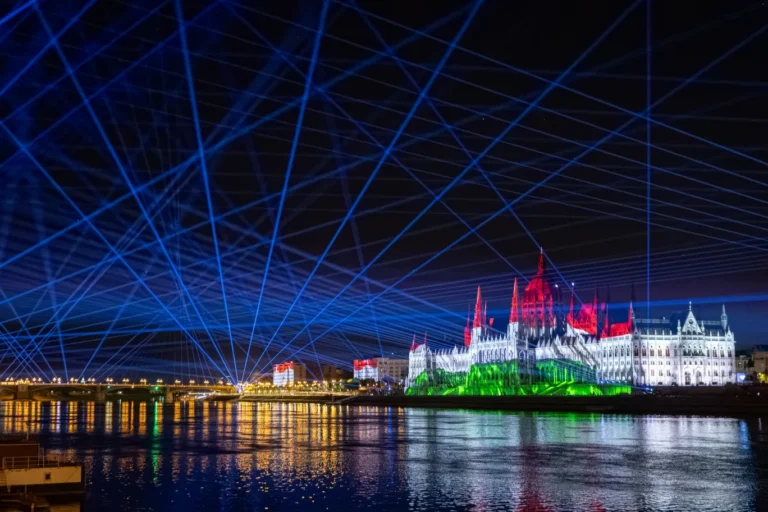
Panasonic PT-RQ45K projection mapping in Budapest: 83 projectors for St Stephen’s Day
Panasonic deployed 83 laser projectors — 67 PT-RQ45K and 16 PT-RQ35K — across the Hungarian Parliament Building, the Széchenyi Chain Bridge and the Pest embankment for Hungary’s St Stephen’s Day celebrations in Budapest.

What event production covers and how the work is organised
Event production covers an ever broader market with very different ways of working: from the festival and the concert to the wedding with a wedding planner, the trade show and the MICE event of meetings, incentives, conferences and exhibitions. Behind that variety are two underlying movements: the professionalisation of the sector, with formal training, degrees and dedicated master’s programmes, and the expansion of the corporate market, which has given rise to companies specialising in a single stretch of the production.
Technical production is the part that lands that idea in a venue: permits, org chart, contracting suppliers, safety, regulations and promotion, each with its own deadline and its own owner. The regulatory stretch — self-protection plan, coordination between companies, rigging, temporary power and evacuation — is set out in the guide to safety in technical event production, and the work on site in event setup, event structures and truss structure.
Control comes from two things: a workflow with explicit tasks, deadlines and ownership — in production, saving time is saving money — and a double budget, preventive and estimated, that separates what is expected to be spent from what is actually needed. The same logic of phases that organises audiovisual production applies here, and the kit that goes on stage is covered in event products.
The questions that define a production
Before a single case is moved, a production rests on eight questions that order the approach, and a ninth that closes it once the event is over.
What?
What the event is built on: its purpose, its theme, its qualities and the vision and mission it has to convey.
Why?
The objective and the reasons for planning and creating the event. Without that why, every later decision is taken without a yardstick.
What for?
The target or market niche it is aimed at, and the specific outcome expected from it.
When?
Dates and times that build anticipation and drawing power, and that leave a real window for get-in and get-out.
Where?
Ease of access, facilities, parking, capacity and the venue’s infrastructure. The detail on capacity, regulations and evacuation is set out in the safety guide.
Who coordinates it?
The org chart and building a team with tasks clearly divided: who decides, who delivers and who answers to the client.
How much?
The project’s financial viability: cost control, making the most of resources, and the involvement of partners and collaborators.
How do I promote it?
The promotion plan, with budget, specific activity, media and timing, delegated to a communications lead.
Did it work?
The post-event evaluation: attendance, commercial activity, press coverage, ticket sales, merchandising and the perspective of the team, the suppliers and the technical crew.
The client brief, the starting point of the commission
When an event’s production is delegated to a production company, the work does not start at the venue: it starts with the client brief. It is a simple document, borrowed from marketing and communications, that profiles the client, their vision and mission, and the product, campaign or cultural proposition they want to deliver. Its value lies in its objectivity: it fixes in writing what has been commissioned and stops the interpretation of the project shifting halfway through.
WHAT A BRIEF CONTAINS
- Project description and objective
- Target and intended audience
- Key message and specific content
- State of the brand
- Style, tone, trends and what is to be achieved
- Duration and delivery deadlines
- Mandatories, tools and content
- Budget
- Promotional materials and merchandising
Explore the events field
The other areas of an event’s cycle on Instalia, from the prior organisation through to the on-site build and hiring the kit.
The commission before the venue: approach, agencies, suppliers and project management.
Rental kit for productions that would rather not tie up their own stock.

Want to feature on Instalia?
If your company produces events, provides technical services or supplies kit for productions, you can present your projects, services and news to Instalia’s professional audience.
HOW IT WORKS