
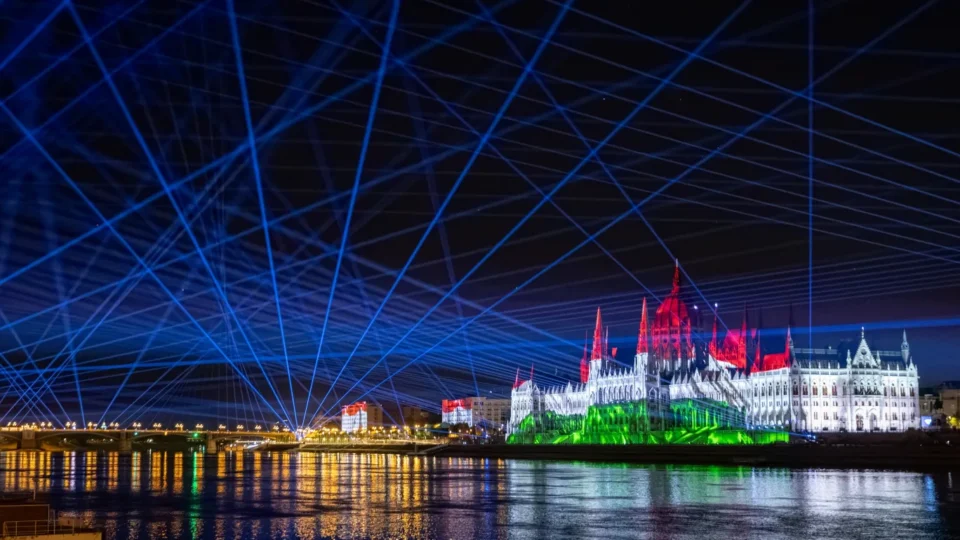
Panasonic Projector & Display put 83 laser projectors along the banks of the Danube for Hungary’s St Stephen’s Day celebrations in Budapest on 20 August. The Panasonic PT-RQ45K projection mapping work accounted for 67 of them, running alongside 16 units of the Panasonic PT-RQ35K, and covered both façades of the Hungarian Parliament Building, the Széchenyi Chain Bridge and several buildings on the Pest side of the river. Panasonic describes it as the largest deployment of the PT-RQ45K anywhere to date.

More than 80 projectors along the Pest embankment
St Stephen’s Day commemorates King Stephen I and the foundation of the Hungarian state. Its Budapest celebrations rank among the country’s largest public events and are traditionally staged around the Parliament Building and the Danube.
The main show turned the stretch of river between Margaret Bridge and the Chain Bridge into a single continuous canvas. Architectural projection did not run on its own here: it was cued alongside lighting, lasers, drones, music and fireworks on a shared timeline, with content built around Hungarian history and national identity.


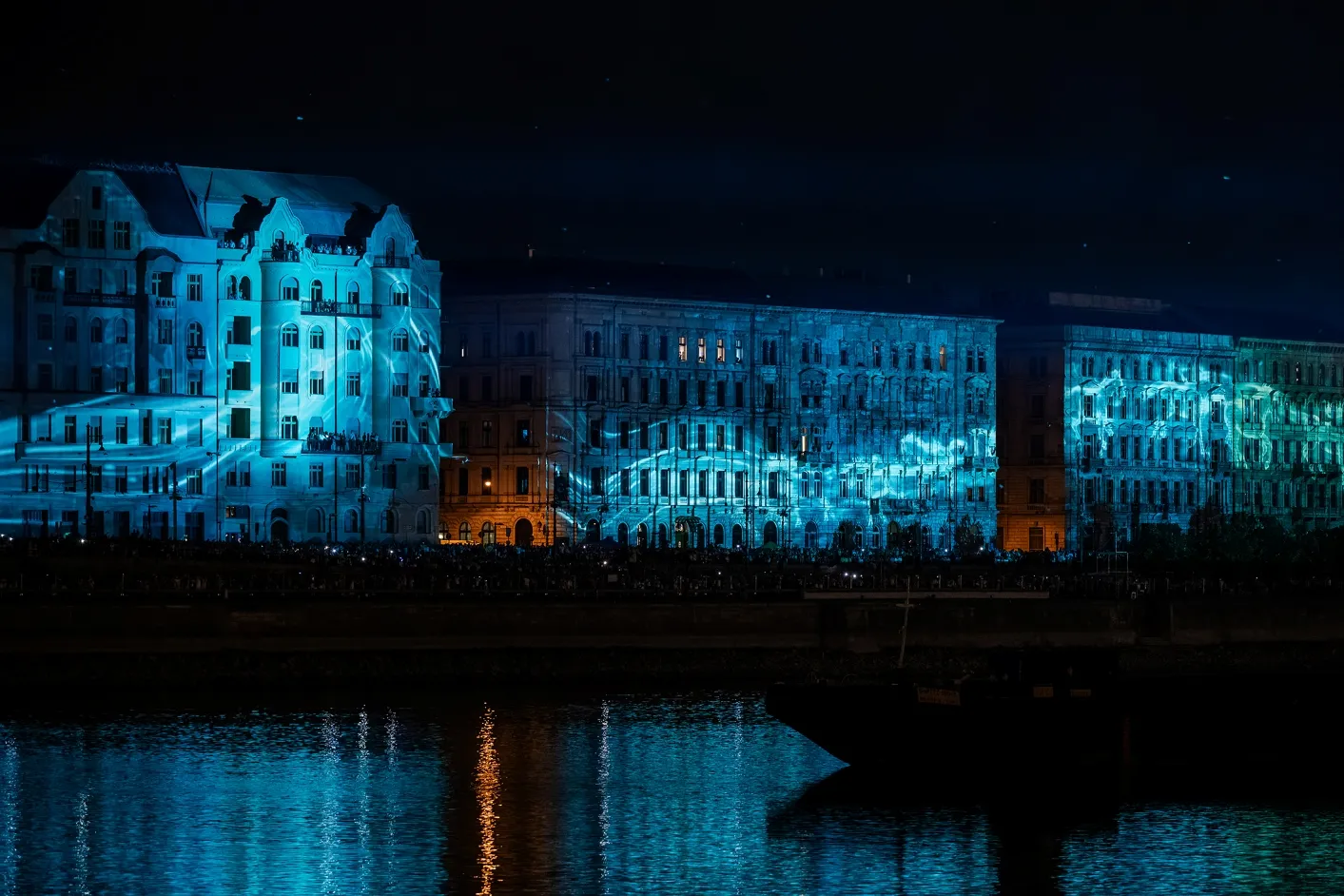
Once the main show finished, the projections on the Parliament Building and the Chain Bridge carried on into the night. That has technical consequences: a projector fleet sized for several hours of continuous outdoor output, rather than for a short cue stack, changes how the machines are distributed and how the rig is monitored across the evening.
The largest PT-RQ45K deployment recorded so far
The 67 PT-RQ45K units are, according to Panasonic, the biggest deployment of the model worldwide to date. It is a recent product, positioned from launch as a 4K 3-Chip DLP projector for rental, scenic work and large-format projection.



The PT-RQ45K pairs 42,000 lumens with 4K imaging in a chassis comparable in size to the established PT-RQ35K series, which shared the Budapest rig with it. Panasonic calls it the world’s smallest and lightest 4K projector in its brightness class — a manufacturer’s claim rather than an independent measurement.
Outdoors, on pale stone, at tens of metres and against urban stray light — street lamps, traffic, the ornamental lighting on the bridges themselves — brightness stops being a catalogue figure. It is the margin between an image that holds contrast and one that washes out. Covering both façades of the Parliament also means spreading that load across many machines while holding the same white level and the same colour response on all of them.
From the spec sheet to a rig of 83 machines
Compatibility with current-generation Panasonic D3LE lenses, frames and flight cases is probably the feature carrying the most operational weight on a project like this: rental and production companies can fold the model into existing fleets without replacing optics or rebuilding rigging hardware, which matters when more than eighty positions have to be prepared in a few weeks. It is the same reasoning that pushes rental houses towards standardised inventory when they expand a fleet with large-venue laser projectors.

On the imaging side, Panasonic’s proprietary Quad Pixel Drive works to a maximum resolution of 3840 × 2400 pixels, a taller frame than conventional 16:9 and better suited to vertical façades such as the Parliament’s towers. The rest of the feature set is about controlling the system: the built-in five-inch Color Information Monitor reports each machine’s status on the unit itself, with no laptop and no network access; the standard 12G-SDI input removes conversion stages from 4K signal paths; and the Intel SDM-compatible slot leaves room for third-party boards.
Remote Preview is the feature that changes day-to-day operation most at this scale. Checking what each projector is actually outputting from the control position, instead of walking positions spread along the embankment, shortens build-day verification and cuts fault-finding time once the show is running.
Six weeks, 300 companies and more than 1,000 professionals
The event was delivered by Centrum Production, with Dániel Besnyő as director and overall project lead, Gergő Geltz as head of light art content and Mátyás Kálmán as artistic director.
Completed in six weeks, the production brought together more than 300 companies and more than 1,000 professionals, including engineers, technicians, manufacturers, filmmakers and creative teams. The artistic side followed the same collaborative pattern: six light art studios and eight independent light artists produced the animations and visual content.
Besnyő, who had already worked with Panasonic projectors on earlier editions of the Hungarian national day celebrations, sets out the starting requirement:
For a production of this scale and complexity, we needed technology capable of delivering outstanding brightness, image quality and consistent operation across an exceptionally large installation.
On a schedule with no room for long trials, the predictability of a fleet the crew already knows counts for as much as the spec sheet.
Projection as one layer of a larger urban show
What makes Budapest interesting professionally is not only the projector count, but the fact that projection worked as one layer inside a show with lasers, drones, lighting, music and pyrotechnics cued across a single urban space, with the river in between.
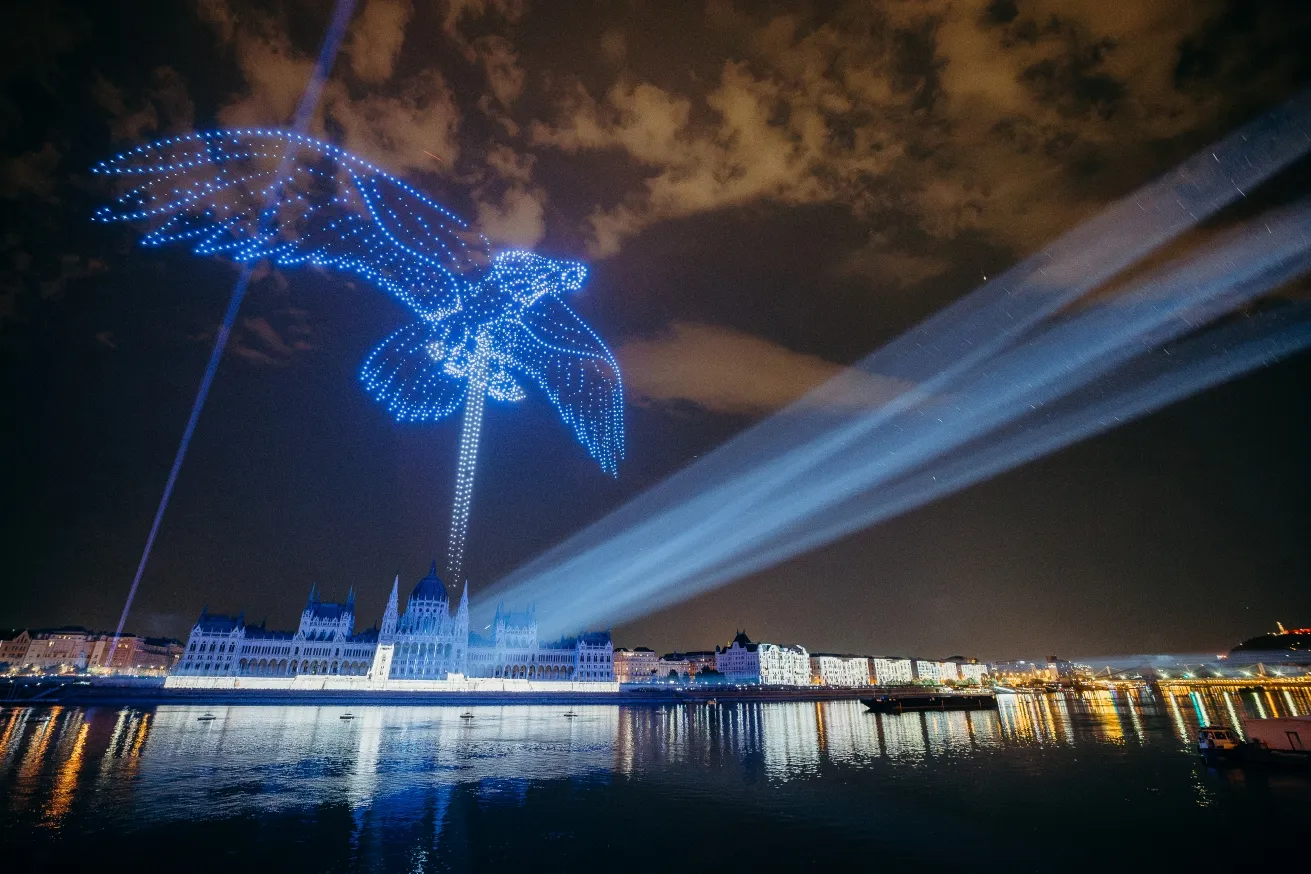
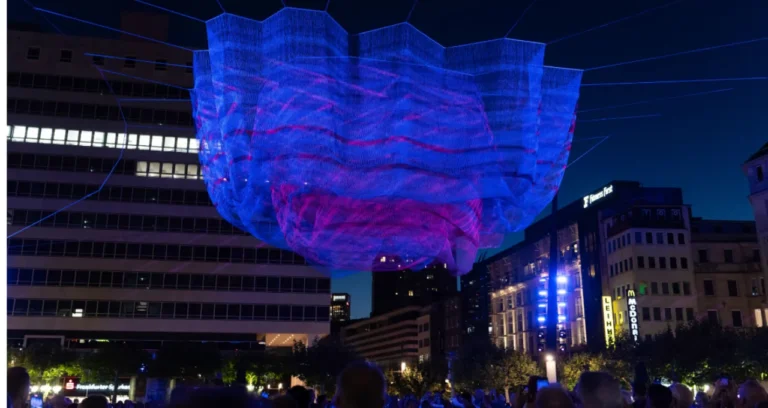
That convergence is reshaping what professional projection mapping is: less a self-contained discipline, more one module inside a multidisciplinary production, with the synchronisation and reliability demands that implies. It places large-scale mapping in much the same operational territory as outdoor architectural light art in public space.
For integrators, rental houses and production companies the practical reading is straightforward: when a model keeps the mechanical and optical compatibility of the previous generation, a jump in brightness can be absorbed without rebuilding the rigging infrastructure. Full specifications are listed on the official PT-RQ45K product page, and the event was produced by Centrum Production.