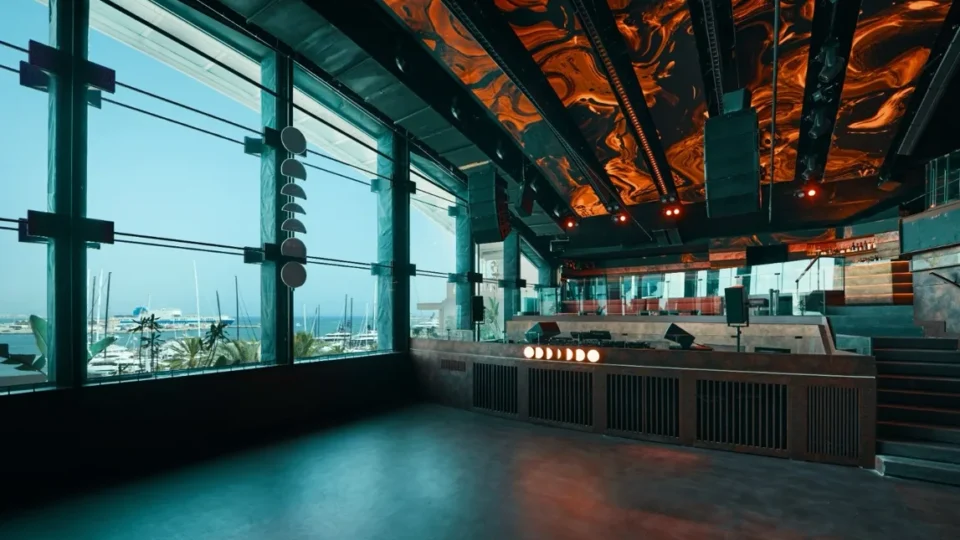
The permanent sound system from d&b audiotechnik at FITZ Mallorca now has a full summer season behind it. The former Tito’s, the club on Palma’s Paseo Marítimo, reopened on 16 July 2026 after its refurbishment, and Party Effects handled the sound, lighting and video. The sound was not solved with a single system for the whole venue: it was split into zones, according to the ceiling height and the use of each space.
Tito’s opened in 1923 and is one of those names everyone links to Palma’s nightlife. The building, at number 32 on Avinguda de Gabriel Roca, looks out over the harbour through a large glazed façade. Its glass and iron dome dates from 1968 and is the work of Estudio Lamela.
It is now run by Grupo Sounds, which already had two other FITZ venues, one on Calle de la Princesa in Madrid and another in Marbella, as well as Vandido, Bonded, Dos Passos, Castellana 8 and Teatro Barceló. All three FITZ clubs share the same tagline: “The House of Artists”.
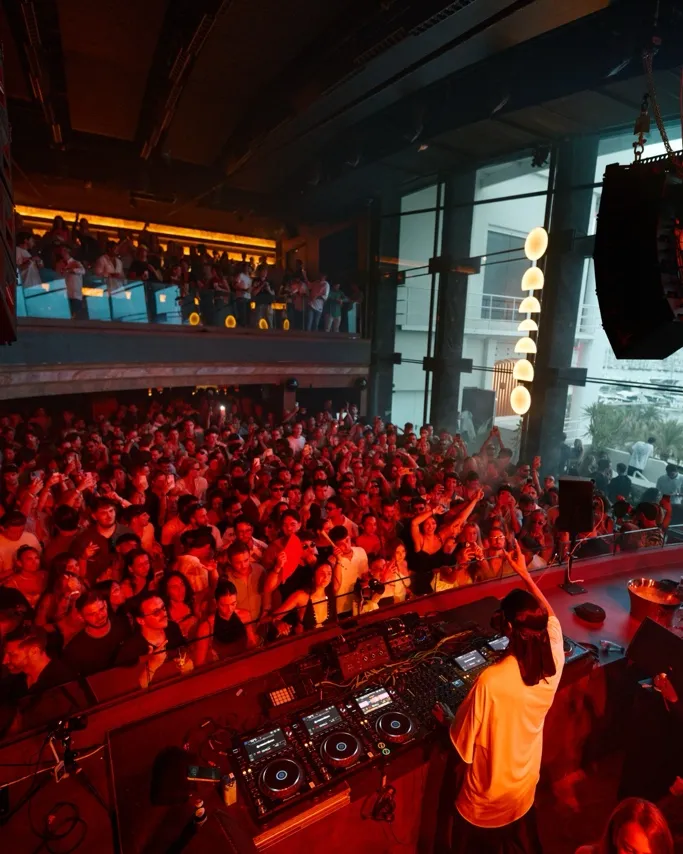
The reopening night was a 12-hour session with PAWSA, Nic Fanciulli and Miguelle & Tons, as reported by Resident Advisor and Mixmag.
The FITZ Mallorca sound system was designed alongside the refurbishment
In the press release d&b audiotechnik sent from Barcelona on 26 November, the brand explains that it joined the project in the earliest design stages. Its application support team was involved in training, basic engineering, system integration and optimisation for live performances.
The first requirement was that the sound should not show in the interior design. That meant coordinating architects, interior designers and lighting installers throughout the works, with the summer opening as the deadline.
And the venue did not make it easy.
Party Effects describes it as “a room with curved ceilings, large windows onto the harbour and several levels”, and some of those levels have low ceilings, so the solution used on the main dance floor would not work there.
The second challenge was acoustic. The club sits right in Palma’s urban fabric, and the project set three goals: a sonic signature of its own inside the room, keeping sound from escaping outside and complying with regulations. The last two depend above all on the building’s sound insulation, meaning its envelope, joinery and acoustic treatments. What the electroacoustic system brings is something else: deciding where the sound energy goes.
A cardioid SL-Series line array to control sound dispersion
The main system is a cardioid SL-Series line array, which Party Effects installed “with line arrays flown over the dance floor”. The reason it is cardioid lies in the low end. There, a conventional loudspeaker becomes almost omnidirectional and radiates nearly as much energy to the sides and rear as it does forwards. The SL-Series cuts back that rear and side energy and concentrates it on the audience, so less of it reaches the stage, the walls and the ceiling.

In a club, that means fewer late reflections and more direct sound relative to reverberant sound, which helps the dance floor keep its definition. It is worth keeping the two things apart, though: directivity does not change the room’s reverberation time, which depends on its volume and materials, and it does not replace the building’s insulation either.
“Our big challenge was to achieve the highest sound quality inside the room without it carrying outside. d&b’s cardioid technology lets us steer the sound precisely and control the reverberation, so we can ask the system for everything a set demands while meeting the required regulations,” explains Chema Álvarez, COO of Grupo Sounds.
That is the operator’s view. The system reduces the energy that excites the room, and regulatory compliance, which the project set as a requirement, also rests on the room’s structural insulation.
The U-Series and Y-Series fit into the low-ceiling areas
Where the ceiling drops, the project turned to two other d&b families. The U-Series, which the brand launched on 15 January 2026, is a range of compact point-source loudspeakers: the passive U3, U5 and U7 and their networked versions U3N, U5N and U7N, which support PoE++ power and Milan-AVB audio. The Y-Series mixes point-source cabinets such as the Y7P and Y10P with small line arrays such as the Y8 and Y12. The press release does not say which models from each series were hung at FITZ.
It makes sense. Those areas need small loudspeakers that disappear into the interior design and give even coverage with the audience very close by. None of these U or Y cabinets is cardioid, so here control comes down to each one’s dispersion and where it is placed.
Bi6-SUB and B22-SUB subwoofers complete the sound system
For the low end, two d&b subwoofers were combined. The Bi6-SUB, which the brand lists within the Y-Series, is the fixed-installation version of the B6-SUB: one 18-inch driver in a bass-reflex cabinet. The B22-SUB goes further, with two 18-inch neodymium drivers in a band-pass horn and a weight of 106 kg. Its datasheet lists nightclubs among its applications.
Neither of them is cardioid by design.
d&b explains that three units, or multiples of three, can form a Cardioid Subwoofer Array with one cabinet facing backwards, but the press release does not say how they are arranged at FITZ.
Design in ArrayCalc and audiovisual installation by Party Effects
Everything was designed in ArrayCalc, d&b’s simulation software. It starts from high-resolution dispersion data measured for each cabinet and calculates coverage and sound pressure levels across the venue in 3D. That makes it possible to decide before installation where each loudspeaker goes, where it points and how the families are distributed.
It is, however, an electroacoustic prediction. It does not calculate the building’s insulation or the room’s actual reverberation time. d&b’s own technical information document TI 385 acknowledges that in highly reverberant rooms, measurements end up above the simulation because of the contribution of the reverberant field.
Party Effects, a Spanish-Chinese company based in Getafe (Madrid) that works with LED screens, lighting, sound and special effects, carried out the turnkey installation with its own team, “from the render to opening night”. According to the project page published by Party Effects, the club has 64 d&b audiotechnik loudspeakers and 105 m² of LED screen on the ceiling. The company also supervised production at source and coordinated logistics all the way to the island.
Electroacoustic design and architecture in a single project
In a permanent venue, how much power there is matters less than how it is distributed. The work of d&b audiotechnik at FITZ Mallorca brings together three decisions that keep coming up when sound is designed for clubs set in the middle of a city: a main system with directivity control for the dance floor, compact loudspeakers where the ceiling leaves no room and a prior simulation that locks in the distribution before the works begin.
The rest depends on how well everything is coordinated with the other trades. In a building from 1923, open to the harbour and surrounded by the city, the sound was conceived as one more piece of the club’s architecture.