
Sennheiser Spectera RF management has let monitor engineer Chris Dwight collapse the wireless infrastructure carried by Puscifer and A Perfect Circle into a single system. The platform combines in-ear monitoring, wireless transmission, bidirectional control and spectrum management, which changes what a monitor engineer has to do before a show as much as what the rack looks like.
RF management with Sennheiser Spectera
Running consecutive tours for two bands — both fronted by Maynard James Keenan — means keeping a wireless infrastructure that adapts quickly to different stages, venues and radio-frequency conditions.
Monitor engineer Chris Dwight has made Spectera the backbone of that workflow, alongside the Digital 6000 system for the vocal chain.
“When you go from a two-month Puscifer tour to one with A Perfect Circle, consistency and efficiency of workflow become fundamental. We weren’t looking for a change for the sake of changing, but for flexibility and long-term scalability.”
Chris Dwight, monitor engineer
Where traditional wireless setups rest on multiple individual narrowband frequencies, Spectera uses WMAS (Wireless Multichannel Audio Systems) technology to concentrate different audio links inside a single wideband RF channel.
The consequence for RF management in professional sound is significant, particularly on productions that need to run large numbers of wireless systems and in-ear monitoring in cities where the available spectrum changes from one date to the next.
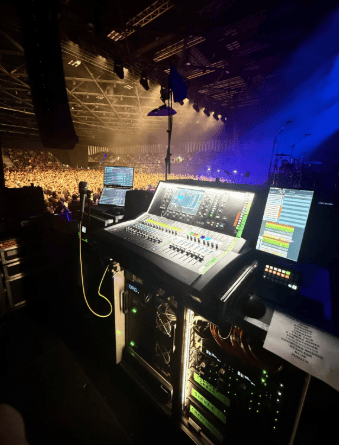
Frequency setup in around ten minutes
One of the things Dwight singles out is how much the system cuts the time needed to prepare the wireless rig before a performance.
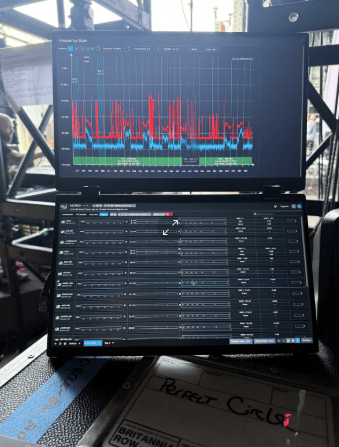
He sets up the scanning antennas, analyses the available frequencies and exports the information to SoundBase. Spectera can concentrate the required channels within a single 6 MHz of bandwidth, which simplifies the process considerably against a conventional setup built on many independent frequencies.
“In the morning I set up my scanning antennas, check the available frequencies and export them to SoundBase. Because Spectera condenses all those channels into a single 6 MHz of bandwidth, the whole thing takes 10 minutes. It’s incredibly fast.”
Chris Dwight, monitor engineer
That matters most on back-to-back tours like these, where the technical team has to keep a repeatable workflow while the venue and the RF environment change constantly.
Changing frequency in the middle of a show
Spectera’s bidirectional control had a particularly telling application during a stadium performance in Salt Lake City.
Shortly before the show, venue or security radio systems began operating in the spectrum in use, generating interference and digital dropouts on some of the artists’ devices.
Dwight was able to locate a new available frequency from the software, deploy it and update the equipment simultaneously while it stayed on the performers.
“Thanks to Spectera’s bidirectional control, I could instantly find a new frequency in the software, deploy it and update all the units simultaneously in a matter of seconds.”
Chris Dwight, monitor engineer
Being able to act on the whole system from a single environment is what makes this relevant for monitor engineers, RF technicians and live sound leads: it cuts the reaction time when the spectrum changes without warning, which on a stadium show is the difference between a fix and a failure the audience hears.

Monitoring and transmission from one system
On stage, Spectera’s SEK bodypack transceivers handle the performer’s in-ear monitoring and wireless instrument transmission at the same time.
That architecture reduces the number of devices required and, according to Dwight, has cut the size of the monitor rack the bands carry considerably.
“My monitor rack is far smaller than it would normally be. Just knowing I can put a 1U Spectera base station in a case, check it onto a plane and have the band’s entire wireless infrastructure with me is a game changer.”
Chris Dwight, monitor engineer
Less infrastructure has logistical consequences too. Space, transport, load-in times and setup speed all form part of the overall performance of a production, in touring as much as in the permanent installations covered under event sound.

Telemetry and remote control of the monitor mix
From the mix position, Dwight can consult information about the devices the performers are using through the system’s web interface and make certain adjustments without physically reaching the bodypacks.
“I can see the real data, even if someone’s earpieces are physically disconnected.”
Chris Dwight, monitor engineer
That proved especially useful because two of the performers wear costumes that keep the bodypacks well hidden. Dwight was able to change their level remotely from the software without interfering with wardrobe during the performance.
Telemetry, remote configuration and bidirectional communication together give the engineer operational information about what is happening on stage and remove a category of physical intervention from the show.
WMAS and scalability for professional touring
WMAS technology is the foundation of Spectera. Rather than administering each wireless link as an independent frequency, the system integrates different channels within a wideband RF architecture.
For productions that change city, venue or festival continuously, that structure makes adaptation to different spectrum conditions easier and allows the system to grow or change without reproducing the complexity of a conventional wireless infrastructure. The same reasoning shapes how large live audio systems are specified elsewhere — coverage, intelligibility and resilience under pressure, as in the Bose Professional stadium sound system at El Alto — and how manufacturers position themselves around live sport, as Sennheiser did on becoming Official Sound Provider of Formula E.
Digital 6000 and MM 435 for the vocal chain
Spectera is not the only Sennheiser system on these tours. For the voice of Maynard James Keenan, the team uses the Sennheiser Digital 6000 wireless system with the MM 435 capsule.
The decision answers a specific need: holding a consistent vocal reference even though the sonic and staging characteristics of the two bands are different.
“They’re two bands with very different sounds. The 6000s with the 435s for Maynard worked perfectly.”
Chris Dwight, monitor engineer
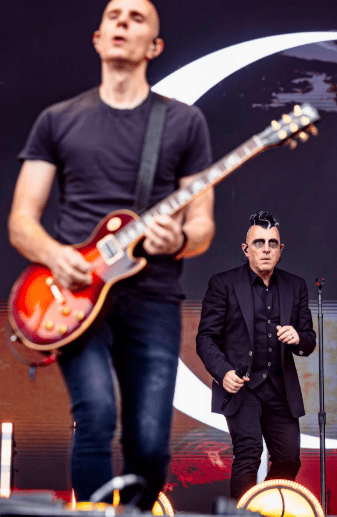
In Puscifer, Keenan moves across different areas of the stage, including a platform some three metres up, as well as between amplifiers and drums. According to Dwight, the combination provides the clarity and articulation required while keeping stage-originating sound under control. With A Perfect Circle the singer stays much closer to the drummer, so keeping the same microphone, wireless system, console and monitoring environment helps the artist retain a familiar sonic reference between the two productions.
The deployment is completed by Sennheiser MD 421 Kompakt microphones on the toms of both bands, chosen to keep the sonic character associated with the MD 421 in a smaller format that is easier to place around a complex kit.
“The MD 421 has always been a legendary drum microphone, but on a crowded stage its classic size sometimes makes precise cymbal placement difficult.”
Chris Dwight, monitor engineer
Spectera in festivals and on the next tours
Dwight is currently on a European tour with A Perfect Circle, where Spectera is also being used in festival environments — the hardest test there is for spectrum management, because the RF picture is shared with every other production on site.
“So far, Spectera has been a success for us in the festival world.”
Chris Dwight, monitor engineer
He expects to extend both bands’ configurations with the new Spectera portable devices once they are available. The change also means letting go of some long-standing assumptions about wireless.
“I understand people being sceptical, because it forces you to see wireless technology from a completely new perspective. This is an incredibly solid, powerful, superbly built device. I intend to use it on every tour from now on.”
Chris Dwight, monitor engineer
The Spectera base station and its accessories are available to order, while the Spectera SKM handheld transceiver can be pre-ordered and is expected to begin shipping during autumn 2026. More information is available on the Sennheiser website; in Spain, Magnetron distributes the brand.
What is WMAS in Sennheiser Spectera?
WMAS (Wireless Multichannel Audio Systems) concentrates multiple audio links inside a single wideband RF channel instead of managing each link as an independent narrowband frequency. In Spectera it allows the channels a touring production needs to sit within roughly 6 MHz of bandwidth.
Can Spectera change frequency during a performance?
Yes. Spectera’s bidirectional control lets the engineer find a new available frequency in the software and deploy it to every connected bodypack simultaneously, in seconds, without taking the units off the performers — as Chris Dwight did during a stadium show in Salt Lake City.
What Spectera changes about the monitor engineer’s day
Sennheiser Spectera RF management on the Puscifer and A Perfect Circle tours shows how a wideband WMAS infrastructure reshapes the tasks that fill a monitor engineer’s day: setup in around ten minutes, frequencies and devices editable remotely, IEM and instrument transmission from the same bodypack, and a rack small enough to fly as baggage. Alongside Digital 6000, MM 435 and MD 421 Kompakt, it holds technical continuity across two productions with very different staging needs.