
ADC Production has added ten Christie Griffyn 4K50-RGB projectors to its rental fleet, strengthening the Belgian company’s capacity for large-format projection, live events and architectural projection mapping. Built by Christie, the model is a 3DLP pure RGB laser projector rated at 50,000 lumens, with support for the Rec. 709 and P3 colour spaces and coverage of up to 98% of Rec. 2020. For a rental house, buying ten identical units is not simply a question of brightness: it sets the ceiling on the jobs the company can take on.

Ten Griffyn 4K50-RGB projectors join the ADC Production fleet
Founded in 1988, ADC Production is a Belgian audiovisual rental and technical support company serving event organisers, based in Zaventem, in the Brussels area. The ten units are not replacing one technology with another inside a single venue: they enter a pool built for temporary productions and can be deployed in different configurations depending on surface, throw distance and the demands of each build.
That is what separates a rental purchase from a fixed install, which is specified once. Rental work needs interchangeable, colour-matched units so that two, four or ten projectors can be combined without rebuilding the image reference for every event. In Asia, other fleet investments aimed at rental and mapping work with the same projector have already been documented.


Christie states that ADC Production is the first audiovisual rental company in its region to add the Christie Griffyn 4K50-RGB, without specifying the geographic scope of that claim: the point comes from the manufacturer.
50,000 lumens and pure RGB laser for large-format projection
The 50,000-lumen figure describes the light output the projector delivers, not its resolution or its contrast ratio. Christie specifies 50,000 ISO lumens —44,500 ANSI— and a native 4K resolution of 4,096 x 2,160 pixels on a 3DLP architecture. Brightness sets how far the image will carry; resolution determines how much detail survives once it is scaled up.



The light source is pure RGB laser rather than laser phosphor: the three primaries come from dedicated laser emitters instead of a blue laser exciting a material to produce the rest of the spectrum. Hence the stated coverage —Rec. 709, P3 and up to 98% of Rec. 2020— a percentage that refers to that reference space, not to 98% of all visible colours.
In mapping that width matters, because content leans on heavily saturated reds and greens that a narrower gamut forces the pipeline to compress. The specifications of this 3DLP pure laser projector already pointed to that use profile.
Christie attributes the projector’s stability to three elements. Christie TruLife+ electronics handle image processing and pixel bandwidth —1.2 Gpx/s according to the datasheet— rather than content playback. The sealed optical engine keeps dust out of the optical block, which is not the same as weather protection. And solid-state illumination removes lamp replacement, though not maintenance.
Olivier Collet, senior business development manager at Christie, places the model in “today’s most demanding live events and mapping projects” on the strength of its brightness, colour performance and operational flexibility.
Two projectors on the facade of Notre-Dame-de-la-Treille
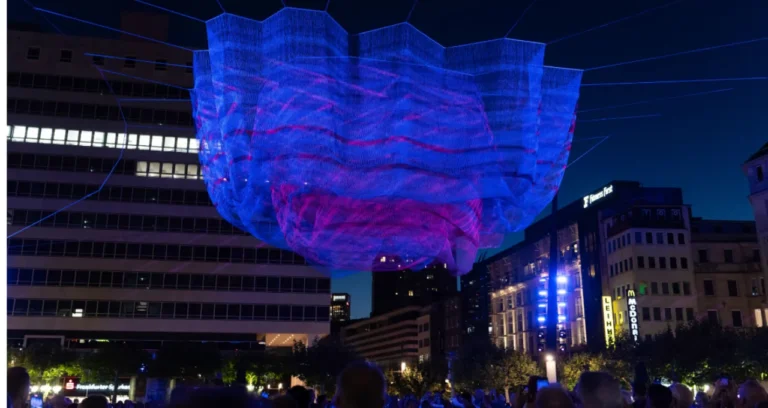
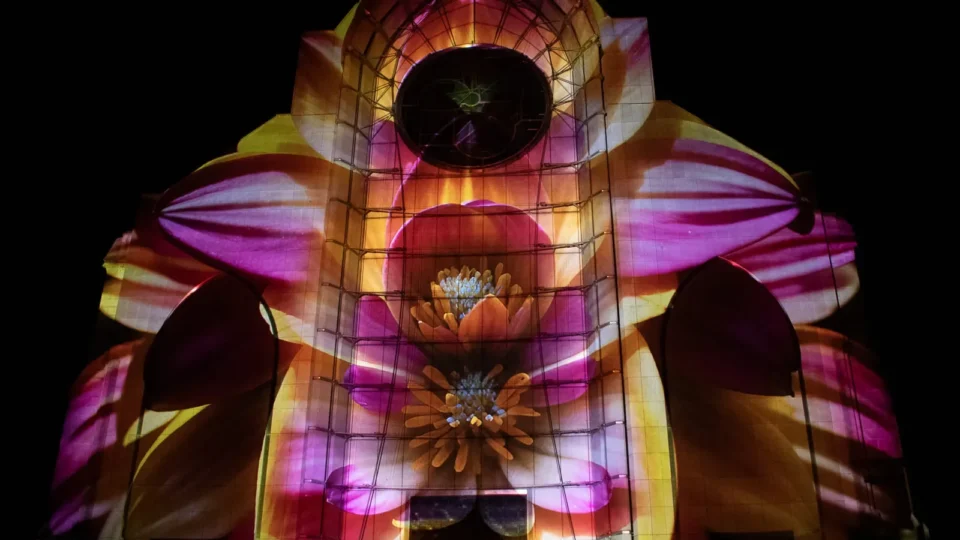
ADC Production’s Christie Griffyn 4K50-RGB projectors have already been used at the Video Mapping Festival in Lille, organised by Rencontres Audiovisuelles. Its ninth edition, on 10 and 11 April 2026, included the facade of Notre-Dame-de-la-Treille cathedral on the outdoor route. The initial plan called for three units; two were used in the end.
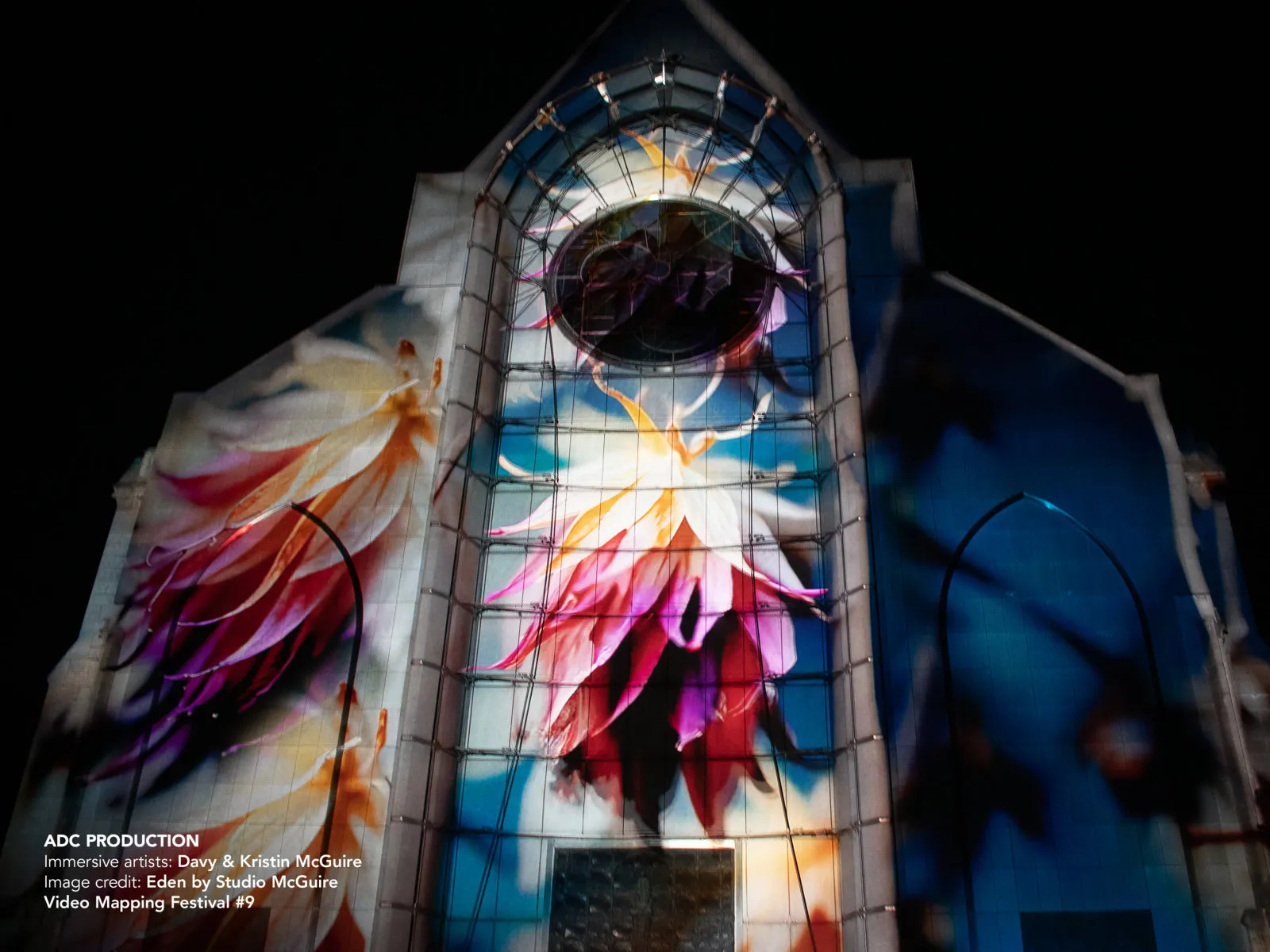
What makes that figure interesting is the brightness headroom it implies, not that it can be generalised. Two projectors were enough in Lille because of the specific surface, the throw distance from the rigging positions, the ambient light on the square, the lenses fitted and the brightness the content demanded. Change any of those and the calculation returns a different unit count.
The cathedral mapping was created by British studio Studio McGuire. Projecting onto heritage buildings adds surface and rigging constraints that the manufacturer has already dealt with in other projects on historic architecture.
More flexibility for live events and mapping projects
Ten identical units change the planning above all: they allow simultaneous events to be covered without mixing projector generations, backup equipment to be held for critical builds, and a system to be scaled with matching hardware.
Reaching a given brightness level with fewer projectors has logistical consequences —fewer rigging positions, fewer signal and power runs, less structure— but it does not automatically mean a simpler build: it concentrates the light load in fewer positions and may call for tighter positioning, specific lenses or finer blending.
Louis Van Ruyssevelt, spokesperson for ADC Production, says the brightness and performance of the new Griffyn 4K50-RGB units let the company take on larger projects, and describes their effect on installs:
“It also gives us more flexibility during installations. In some cases we can achieve the impact required using fewer projectors, which is a real advantage for our clients and for us,” says Van Ruyssevelt.
He adds that reliability and fast setup are decisive in live work, where there is little room to correct a fault. With this fleet, the company says it can take on international jobs comparable to other projections on large-scale facades already documented.
A technology partnership spanning more than 25 years
According to the manufacturer, ADC Production was founded in 1988 by Daniel Van Ruyssevelt —Louis’s father and the company’s managing director— and has since refreshed its inventory through successive generations of Christie technology: digital projection, then laser and now pure RGB laser. The relationship between the two companies spans more than 25 years.
Switching projection platform means reworking calibration references, technician training and lens and spares stock, so staying with a familiar line cuts that internal cost. The company, which offers sound, lighting and video mapping services for event organisers, works from Belgium and beyond its borders.
Christie strengthens its position in professional large-format projection
Christie Digital Systems USA, Inc. builds the Griffyn 4K50-RGB and is a wholly owned subsidiary of Ushio Inc., the Japanese group listed in Tokyo under JP:6925. Its origins go back to 1929, when S. L. Christie started a battery charger and power supply business in California that turned decades later towards cinema: in 1999 it was among the first manufacturers to move into digital cinema, and that year “Toy Story 2” premiered on a DLP projector from the brand.
Its work now spans cinema, large events, themed entertainment, architectural mapping and permanent installations. Christie’s catalogue of visual technologies covers pure RGB laser projection, image processing, signal distribution over SDVoE, and LED and LCD displays.
ADC Production’s decision points to a gradual shift in the rental market. Pure RGB laser reached fixed installs, domes and large attractions first, where a projector is calibrated once and stays in position for months. A rental fleet means rigging, de-rigging and realigning it several times a year without the image drifting: there, unit-to-unit consistency counts as much as the datasheet.